
Introduction
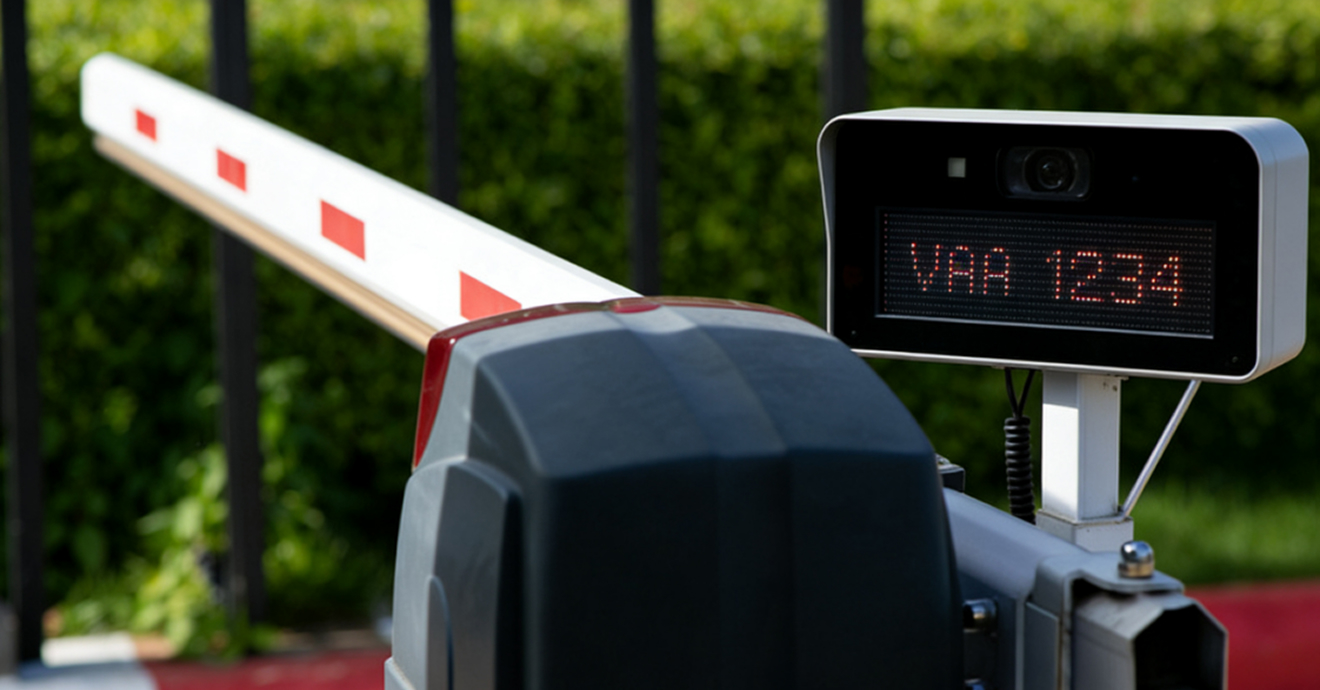
Trying to manually check every vehicle entering your property can take up time and resources, especially during busy periods. Instead of relying on guards or manual records, many property owners now use License Plate Recognition (LPR) systems to automatically identify vehicles as they enter and exit.
By automatically reading and recording vehicle number plates, LPR systems streamline parking operations and access control while improving security and traceability. As a result, they have become increasingly common across commercial buildings, campuses, gated communities, and car parks throughout Malaysia. This article breaks down the technology, key components, benefits, and emerging trends that are shaping modern LPR parking systems.
What is LPR (License Plate Recognition)?
LPR parking refers to a vehicle access and management system that uses License Plate Recognition (LPR) technology to identify vehicles through their registration plates. Instead of relying on physical tickets, RFID cards, or manual entry, the system automatically captures and reads a vehicle’s plate number at entry and exit points.
LPR systems are also commonly known as ANPR systems, which stands for Automatic Number Plate Recognition. The two terms are often used interchangeably across different markets. Curious about the differences? We break them down in our guide to ANPR vs. LPR.
Benefits of LPR Parking Systems
- Faster entry and exit: No tickets, no fumbling for cards. Vehicles are identified automatically, keeping traffic moving smoothly even during peak hours.
- Tighter access control: Only authorised vehicles get through. Every entry and exit is logged with a plate image and timestamp, giving operators a complete, auditable record without manual effort.
- Less reliance on manpower: Automated plate reading handles what used to require guards, logbooks, and manual checks, freeing your team for higher-value work.
- Better user experience: License plate recognition systems eliminate the hassle of managing access cards and parking tickets, helping create a smoother journey for regular users.
- Automatic and accurate data: Every parking session is captured and timestamped. That data feeds directly into your reporting, auditing, and parking management workflows.
- Lower operating costs: Removing ticket printers and manual validation from the equation cuts both maintenance spend and ongoing labour costs.
- Fewer revenue gaps: Every vehicle is tracked from entry to exit. That visibility closes the door on unpaid sessions and makes revenue reconciliation significantly cleaner.
- Built to scale: As vehicle volumes grow, the system keeps pace without adding administrative overhead or requiring significant infrastructure changes.
How Does an LPR Parking System Work?
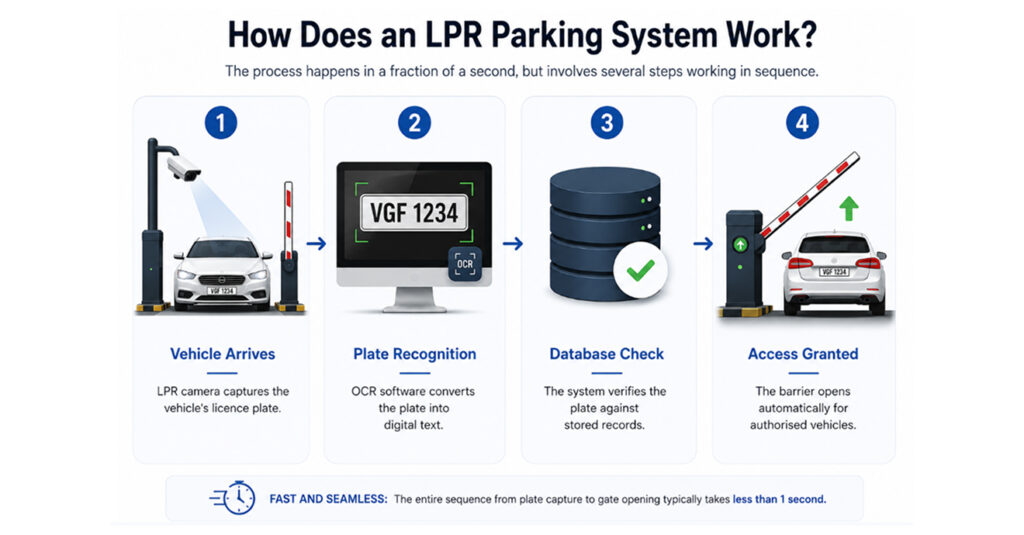
The process of license plate recognition happens in a fraction of a second, but involves several steps:
1. Image Capture
As a vehicle approaches an entry or exit point, a specialised LPR camera captures a high-resolution image of its front or rear plate. These cameras use built-in infrared (IR) illumination to produce clear, accurate images in any conditions, from bright midday sun to a dimly lit basement car park.
2. Image Analysis and OCR
The captured image is passed to the system’s software, which isolates the licence plate from the rest of the image. It then applies Optical Character Recognition (OCR) to convert the characters on the plate into readable digital text.
Modern LPR systems use machine learning algorithms to handle real-world challenges such as partial obstructions, varying plate formats, different fonts, and adverse weather conditions.
3. Data Matching
Once the plate number is converted to text, the system cross-references it against a database in real time. Depending on the facility, this could be a permit holder list, a pre-booking registry, a blacklist of flagged plates, or a session log that tracks entry and exit times for billing.
4. Action
The system then triggers the appropriate response. Authorised vehicles get an automatic barrier lift. Unrecognised plates may be denied access. The whole sequence, from plate capture to gate opening, typically takes only a few seconds.
Besides that, every transaction is logged automatically, capturing the plate image alongside a precise date and time stamp, building a complete, searchable record of every vehicle that passes through.
Key Components of an LPR Parking System
A complete LPR parking setup typically includes the following:
- LPR cameras: Specialised fixed or mobile cameras with built-in IR illumination for accurate plate capture in any lighting condition
- Recognition software: The OCR engine that reads and converts plate images into text data
- Management platform: The backend system where operators manage permit lists, blacklists, session records, and reporting
- Barrier gates or access control hardware: The physical output that the system controls based on plate verification results
- Payment integration: Optional connection to cashless payment terminals, mobile payment apps, or automated billing systems
What is LPR Parking Used For?
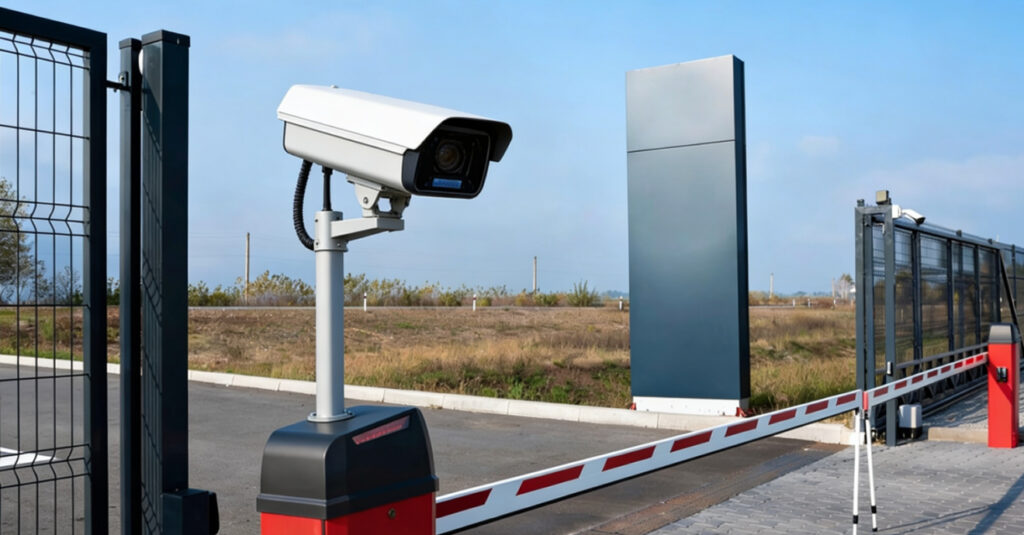
LPR parking technology serves a wide range of applications across different property types and industries:
- Commercial Car Parks and Retail Facilities: Parking entry, exit, and billing are automated, reducing queues and eliminating reliance on physical tickets.
- Residential Buildings and Gated Communities: Seamless resident access is enabled through registered vehicle plates, while visitor management and access control are supported.
- Office Buildings and Corporate Campuses: Staff parking is streamlined, visitor access is controlled, and integration with building management systems is supported.
- Hospitals and Healthcare Facilities: Congestion at entry points is reduced, and parking management for staff, patients, and visitors is simplified.
- Airports and Transport Hubs: Automated parking operations, pre-booked parking, billing automation, and drop-off zone monitoring are supported.
- Industrial Sites and Logistics Facilities: Access for staff and authorised vehicles is controlled while detailed vehicle movement records are maintained.
- Toll Collection: Vehicles are identified automatically for cashless tolling and improved traffic flow.
- Law Enforcement and Security: Stolen vehicles and flagged vehicles can be identified, while investigations are supported through vehicle data.
- Traffic Monitoring and Enforcement: Vehicle data is captured for traffic analysis, speed enforcement, and road usage monitoring.
- Border Control and Customs Checkpoints: Vehicle verification is facilitated, records are maintained, and security screening processes are enhanced.
Technical Requirements for LPR Systems
Implementing an LPR system involves more than just selecting a camera and pointing it at a lane. To help you plan a successful deployment, here is a breakdown of the key technical requirements for each layer of an LPR system:
- Camera Hardware: Resolution should match the number of monitored lanes. 1080p is typically sufficient for one or two lanes, while 5MP or higher is recommended for wider coverage. Purpose-built LPR cameras are designed for plate capture and are often paired with overview cameras for vehicle identification.
- Frame Rate: The required frame rate depends on vehicle speed. Lower-speed environments can operate effectively at 5-15 fps, while faster-moving traffic may require 30 fps or more to ensure reliable plate capture.
- Camera Placement: Accurate recognition depends on proper positioning. Industry best practice is to keep both the vertical tilt angle and horizontal offset angle below 30 degrees, preventing licence plate characters from appearing distorted to the OCR software.
- Lighting: Consistent illumination is essential for reliable performance. Infrared (IR) lighting is the industry standard, helping improve plate visibility in low-light conditions while reducing the effects of headlight glare.
- Shutter Speed: Fast shutter speeds help minimise motion blur. For most deployments, a shutter speed of at least 1/250 second is recommended to maintain image clarity and OCR accuracy.
- Network Infrastructure: LPR systems can use either server-based or edge-based processing. Edge-based systems process recognition directly on the camera, reducing bandwidth usage and improving system resilience.
- Software Configuration: Detection zones, plate size settings, and OCR profiles must be configured correctly. Modern AI-powered software can support multiple plate formats and improve recognition performance under varying conditions.
- Environmental Factors: Weather, lighting conditions, plate quality, and background complexity can all affect accuracy. Conducting real-world testing before deployment helps ensure the system performs as expected.
LPR Parking vs Traditional Parking Systems
Here’s a side-by-side comparison of LPR parking and traditional parking systems:
| Feature | LPR Parking System | Traditional Parking System |
|---|---|---|
| Vehicle Identification | Automatic licence plate recognition | Tickets, RFID cards, or manual verification |
| Entry & Exit Speed | Fast, automated processing | Slower due to ticket collection or card tapping |
| User Experience | Ticketless and cardless access | Users must manage tickets or access cards |
| Security & Traceability | Automatic vehicle records and audit trails | Records depend on ticketing systems or manual logs |
| Operating Costs | Lower long-term operational overhead | Higher ongoing costs for consumables and administration |
| Scalability | Easily handles higher vehicle volumes | May require additional staff and equipment as usage grows |
| Access Control | Plate-based access permissions | Card-based, ticket-based, or manual approval |
| Data Accuracy | Automated and consistent | More prone to human error |
How is an LPR System Set Up?
1. Site Assessment
An evaluation of traffic flow, vehicle speed, lane configuration, lighting conditions, and access control requirements.
2. Camera Position Planning
Identification of suitable entry and exit points with clear visibility of approaching vehicles.
3. LPR Camera Installation
Placement of specialised LPR cameras at the appropriate height and angle. For optimal recognition accuracy, both the vertical and horizontal viewing angles are generally kept below 30 degrees.
4. Network Connectivity
Connection of cameras to the local network for image transmission, plate recognition, and system communication.
5. Software Configuration
Configuration of recognition settings, plate formats, user permissions, and data management parameters.
6. System Integration
Integration with boom barriers, parking management software, payment systems, visitor management platforms, or access control systems.
7. Database Setup
Creation of vehicle databases containing authorised vehicles, resident vehicles, employee vehicles, visitor lists, or watchlists.
8. System Testing and Optimisation
Verification of recognition accuracy, barrier response times, and overall system performance under actual operating conditions.
9. Operational Deployment
Transition into daily operation, supported by ongoing monitoring, maintenance, and performance reviews.
Emerging Trends in LPR Technology
1. AI-Powered Recognition
Modern LPR systems use AI and deep learning to improve recognition accuracy across different lighting conditions, plate formats, and vehicle speeds. Compared to earlier rule-based systems, today’s platforms can identify plates more reliably while reducing false readings.
2. Edge Processing
Many modern LPR cameras can process plate recognition directly on the device rather than relying on a central server. This reduces response times, speeds up barrier gate operation, and allows the system to continue functioning even if network connectivity is interrupted.
3. Advanced Vehicle Recognition
Modern systems can identify more than just licence plates. Depending on the platform, they can also recognise vehicle make, model, colour, and other attributes, providing additional data for security, investigations, and facility management.
4. Cloud-Based Management
Cloud-connected platforms make it easier to manage multiple sites from a single dashboard. Operators can access data remotely, generate reports, and scale deployments without significant investment in on-site infrastructure.
Conclusion
As parking facilities continue to evolve, LPR parking systems offer a more efficient alternative to traditional ticket- and card-based solutions. By using licence plates as digital credentials, they enable a seamless ticketless and cashless parking experience while improving security and operational efficiency.
Whether you’re managing a commercial car park, residential development, campus, or industrial facility, the right LPR system can streamline vehicle access and simplify day-to-day operations. Contact us today at CMC Solutions, a trusted security system supplier in Malaysia, for a free site assessment and consultation to find the best solution for your property.
Frequently Asked Questions about LPR Parking
1. What does LPR stand for in LPR parking?
LPR stands for License Plate Recognition. In a parking context, it refers to a system that uses cameras and software to automatically read vehicle plates and manage access, billing, and security without physical tickets or access cards.
2. How accurate are LPR parking systems?
Modern LPR systems achieve high recognition accuracy, typically above 90%, even in challenging conditions such as low light, rain, or partially obscured plates. Machine learning continuously improves performance over time.
3. What happens if the system cannot read a plate?
Modern LPR systems achieve high recognition accuracy, meaning manual intervention is rarely required. If a plate cannot be recognised, a fallback process such as intercom assistance, staff verification, or manual payment can be triggered based on the facility’s configuration.
4. How is payment handled in an LPR parking system?
LPR systems can integrate with a range of payment methods, including Touch ‘n Go, debit cards, credit cards, mobile payment apps, and pay-on-foot machines. The system calculates parking fees based on logged entry and exit times and applies the charge accordingly.
5. Is my licence plate data safe with an LPR system?
LPR parking systems capture and store plate images alongside timestamps for operational purposes. Reputable systems limit data retention to what is necessary for billing and security, and operators are responsible for ensuring compliance with local data protection regulations.
6. How can an LPR parking system increase the value of my property?
LPR parking systems can increase property value by improving security, reducing operating costs, and creating a better experience for residents, tenants, employees, and visitors. Well-managed, technology-enabled parking is increasingly viewed as a desirable feature in commercial and residential developments.